
On this page
Every address on a residential proxy list also belongs to someone's home connection. When a Show HN in September offered a lookup for whether your IP had been in a proxy network, the replies said so: "This would probably false positive every CGNAT IP, or am I misunderstanding something?", and "I have a dynamic IP from my ISP and it could very well be someone else's device 3 days or 3 months ago."
So how much real subscriber space does a residential proxy list cover? We measured our Residential Proxy IP database against all the IPv4 space announced on 2026-10-09, by the type of network and by how recently each address was seen.
How much of each network type it covers
| Network type | Announced IPv4 | 90 days | 30 days | 7 days | 1 day |
|---|---|---|---|---|---|
| ISP | 1,861.6M | 3.28% | 1.71% | 0.74% | 0.24% |
| Business | 320.6M | 2.03% | 0.98% | 0.41% | 0.15% |
| Hosting | 460.1M | 0.17% | 0.09% | 0.04% | 0.01% |
| All announced | 3,127.8M | 2.19% | 1.14% | 0.49% | 0.16% |
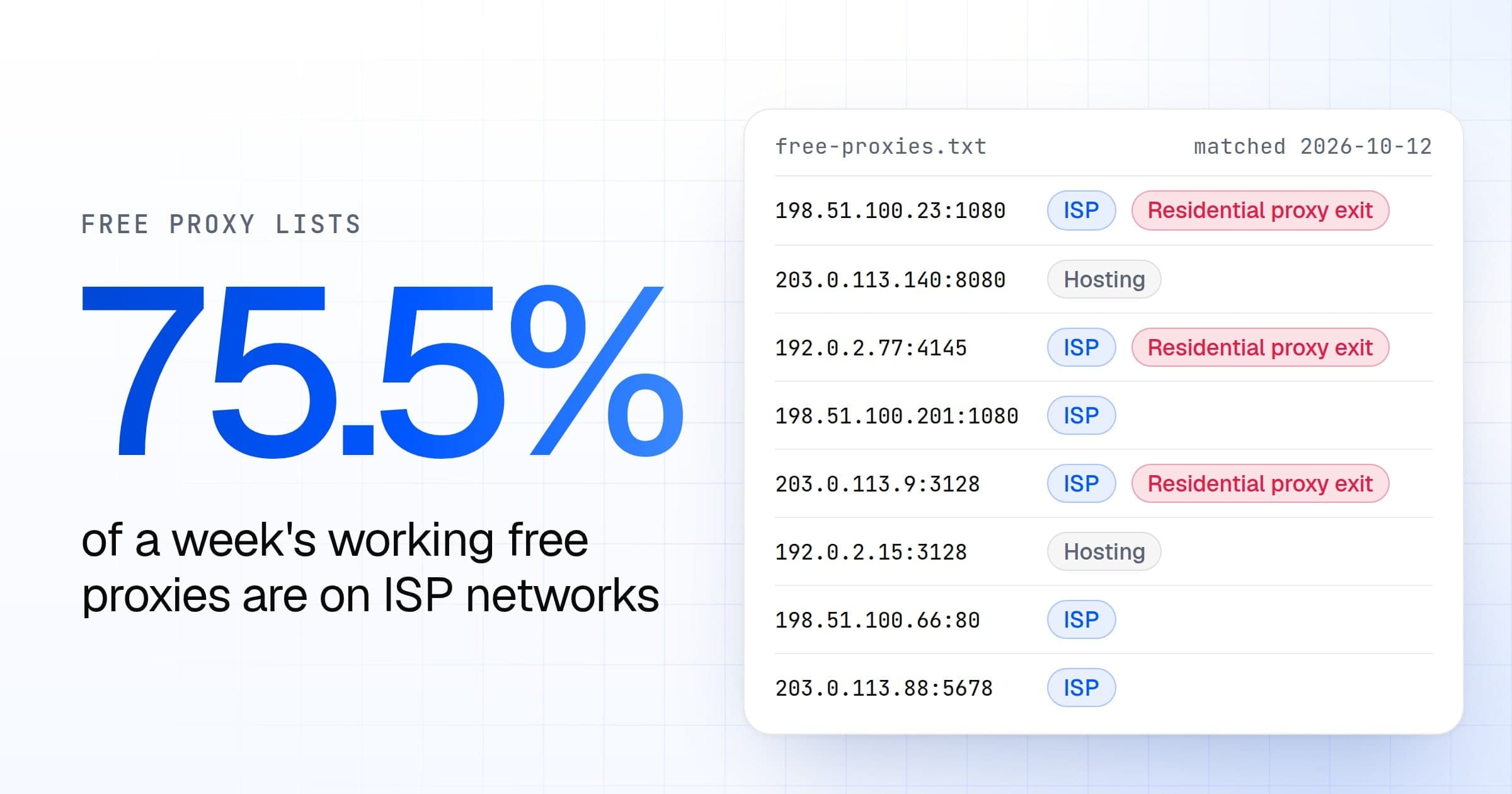
ISP networks hold 89.0% of the 90-day list.
The /24 trap
38.4% of the /24s in ISP space, 2,796,259 of 7,273,878, held at least one address from the 90-day list. In business networks it's 19.7%, and in hosting 3.3%.
So a rule that widens a residential proxy hit to its /24 blocks more than a third of the world's broadband /24s, where the exact addresses are 3.28% of ISP space.
Where it's higher
Most ISP networks have little of their space on the list. Of the 1,382 that announce a /16 or more, the median has 1.05% of its addresses in the 90-day list, and 0.58% in 30 days. 211 have 10% or more over 90 days, and 43 have 30% or more. IPinfo has observed ASNs where the share over 30 days "can reach 15-20%", and that's the tail: 58 of the 1,382 are at 15% or more over 30 days, and 30 at 20% or more.
It also depends on where the network is. By the ISP networks' registry country:
| Country | 90 days | 1 day | ISP /24s with an address on the list |
|---|---|---|---|
| Pakistan | 23.0% | 1.38% | 62.9% |
| Morocco | 21.3% | 0.66% | 37.7% |
| Saudi Arabia | 18.8% | 0.84% | 55.1% |
| Thailand | 17.8% | 0.67% | 44.2% |
| Philippines | 15.3% | 1.72% | 51.0% |
| India | 14.1% | 0.81% | 47.7% |
| Brazil | 7.9% | 0.97% | 45.0% |
| Germany | 2.3% | 0.07% | 53.0% |
| United Kingdom | 2.2% | 0.27% | 58.6% |
| United States | 0.63% | 0.10% | 28.7% |
| Japan | 0.59% | 0.03% | 27.5% |
| South Korea | 0.27% | 0.02% | 28.6% |
Even where the addresses are under 1% of ISP space, as in the US, Japan and South Korea, more than a quarter of the ISP /24s hold one.
A rule that holds up
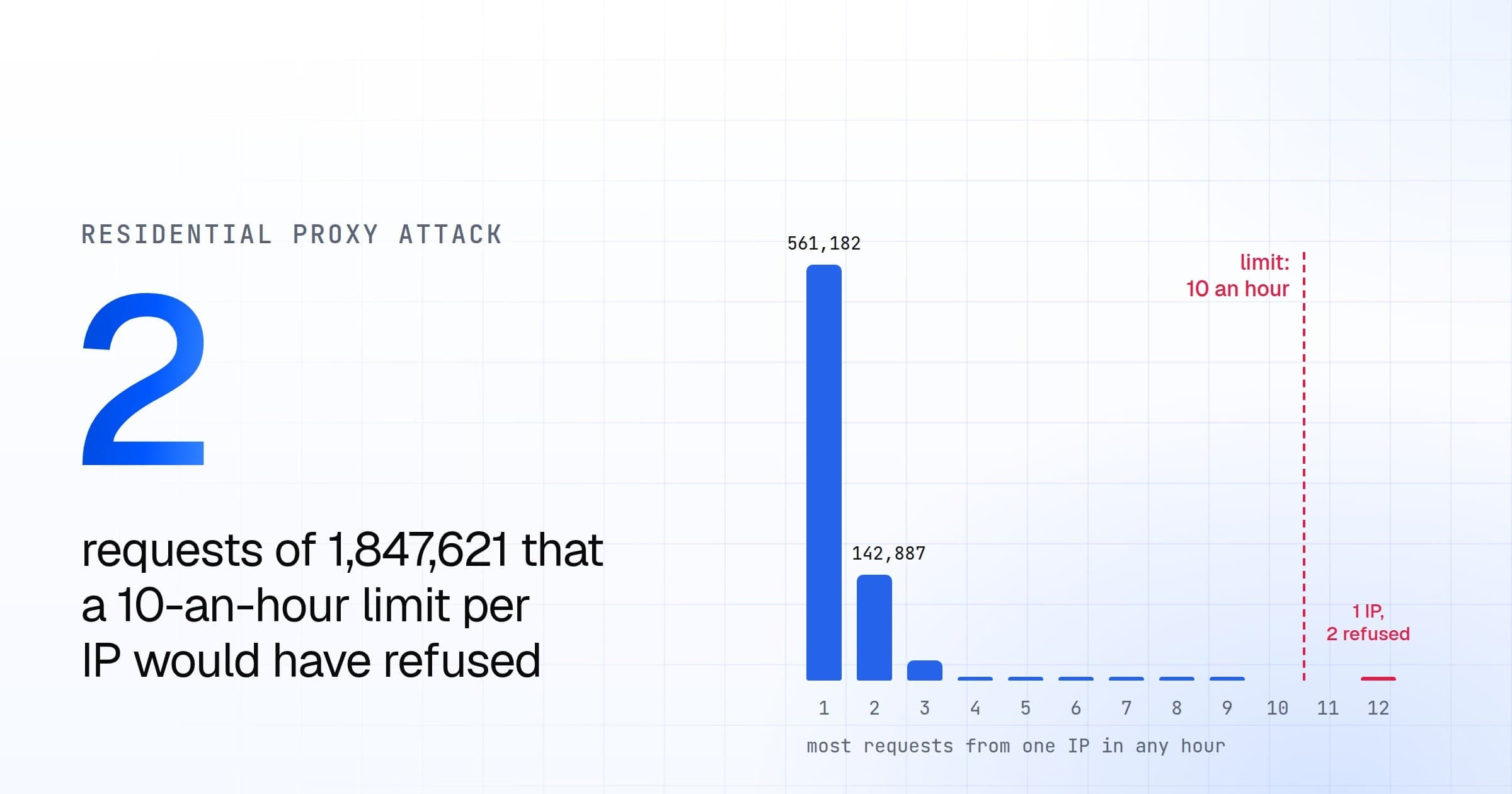
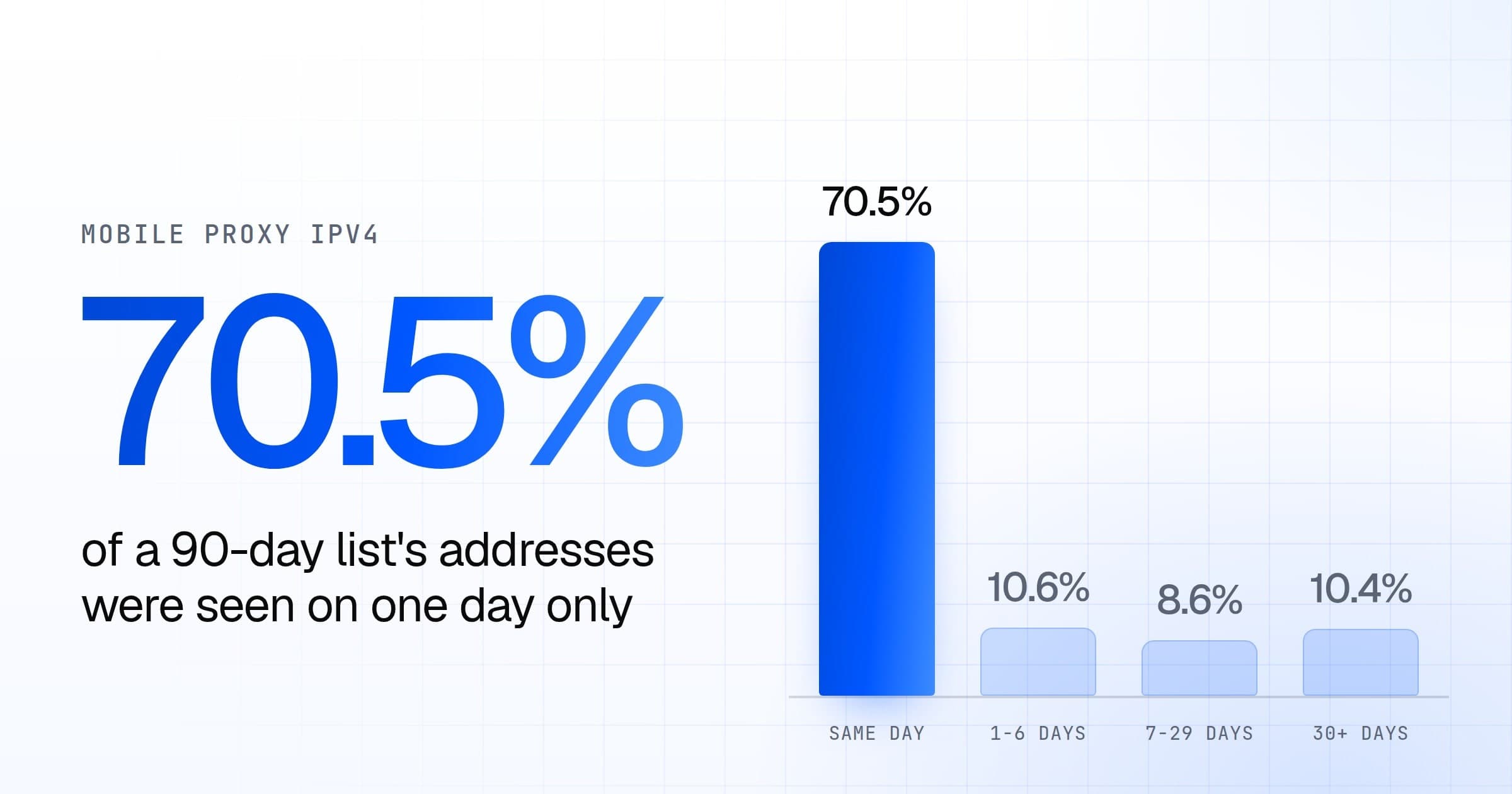
Match the exact address, never its /24 or its network. Act on the addresses seen in the last day or week, which touch 0.24% to 0.74% of ISP space, and treat the rest of the 90-day list as a score that adds to other signals rather than a block. Take more care with traffic from the countries at the top of the table, and from mobile ranges, where one address can serve many people at once. How fast a list goes stale is in How fast does a residential proxy IP blocklist go stale?
How we measured
We took every distinct IPv4 address in the 90-day Residential Proxy IP list on 2026-10-09 and matched it to the network announcing it with IP ASN. Each network's type and country come from the ASN database, the country being the one the network is registered in. The shorter windows count the addresses whose last sighting in the 90-day list falls inside them, and each share's denominator is the IPv4 space the networks of that type or country announce.
To license Residential Proxy IP, see pricing or talk to us.