
On this page
Most listed free proxies don't work. Perino, Varvello and Soriente's Long-term Measurement and Analysis of the Free Proxy Ecosystem (2019) found that "less than 2% of the proxies announced on the Web indeed proxy traffic on behalf of users". In late September, proxy-scraper ran 3.6 million checks in a day and kept 1.1% of them: 54% of the proxies that answered failed a second request, and of the working ones that dropped off its list, 85% were gone by the next hourly check.
Neither answers what a fraud or security team needs to know: whose networks the working ones run on, and whether an IP database already flags them. So we took two samples of working free proxies and matched them against our databases on 2026-10-12.
- A week of listings: every address in IPLocate's free-proxy-list, which is re-tested every 30 minutes, across the 323 versions of its
all-proxies.txtfrom October 5 to 12. That's 10,273 IPv4 addresses on 55,751 address-and-port entries. - Exits: the exit address, the one a website sees, of every proxy on proxy-scraper's list and on monosans/proxy-list, taken at 04:01 UTC on October 12. That's 1,126 exits behind 2,118 listed proxies.
Most are on ISP networks
Network type is our own classification: the type our ASN database (schema) gives the network that announces each address in IP ASN.
| Network type | Week of listings | Exits |
|---|---|---|
| ISP | 7,751 (75.5%) | 644 (57.2%) |
| Hosting | 2,287 (22.3%) | 442 (39.3%) |
| Other | 235 (2.3%) | 40 (3.6%) |
| All | 10,273 | 1,126 |
A block on hosting networks misses three in four of the week's free proxies. proxy-scraper's write-up has 62% of its working proxies exiting from a datacenter: its own classification, on its September list. In the same write-up, Reddit let 86% of the non-datacenter exits through, against 8% of the datacenter ones.
Nearly half of the ISP ones are residential proxy exits
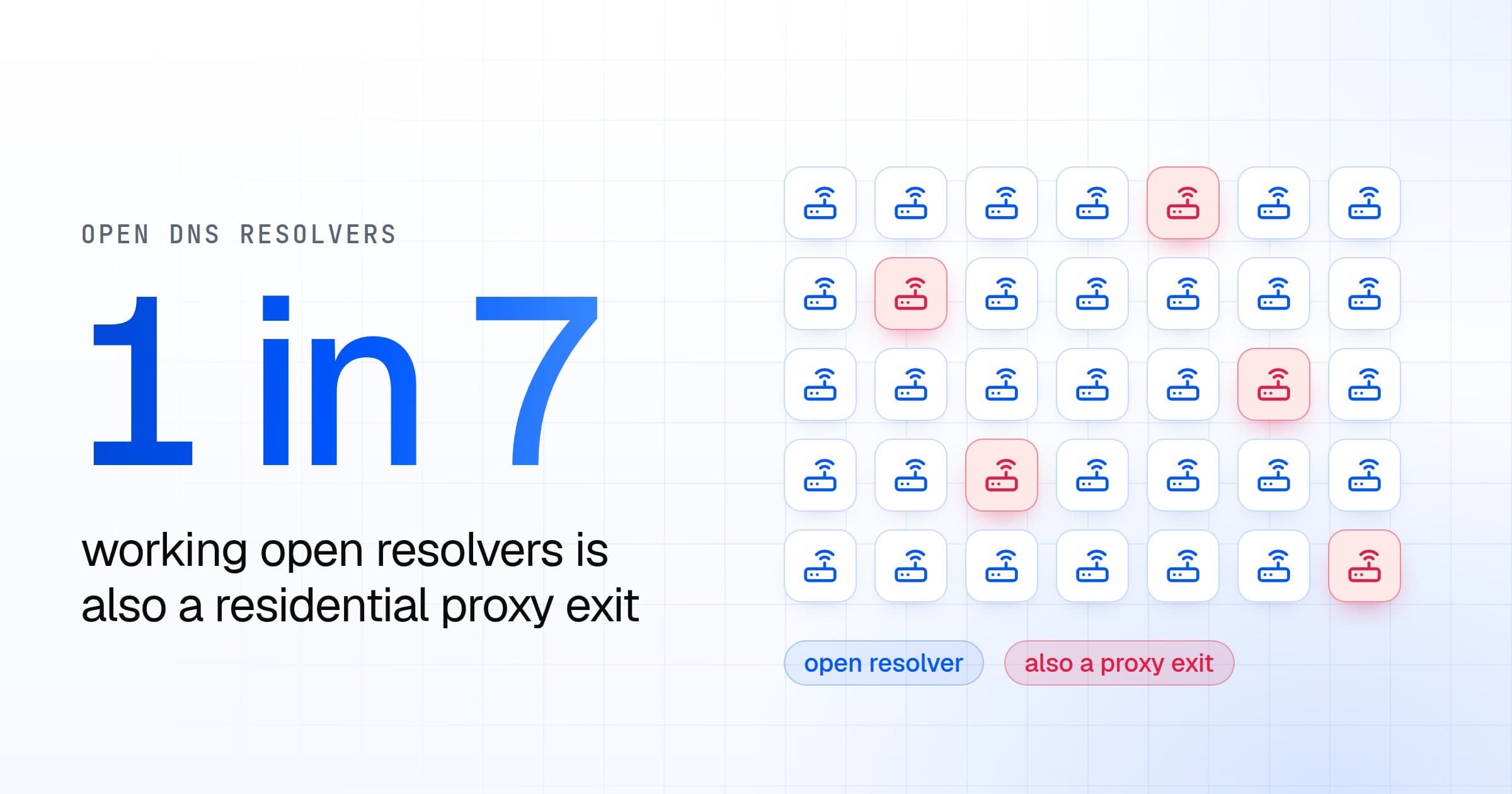
3,676 of the week's 7,751 free proxies on ISP networks, 47.4%, are in our Residential Proxy IP database's 90-day list: seen as residential proxy exits between July 14 and October 11.
| Network type | Week: 90-day list | Week: 7-day list | Exits: 90-day list | Exits: 7-day list |
|---|---|---|---|---|
| ISP | 47.4% | 29.2% | 29.8% | 17.1% |
| Hosting | 2.8% | 0.8% | 12.4% | 6.8% |
| Other | 24.3% | 12.3% | 25.0% | 25.0% |
| All | 37.0% | 22.5% | 22.8% | 13.3% |
2,267 of the 3,676 were seen as residential proxy exits in the seven days to October 11. Half were first seen by July 21, a week after the 90-day window opens. A residential proxy list catches these without a free proxy feed of its own.
Block the exit, not the listing
For 1,290 of the 2,118 proxies on the two lists, 60.9%, the exit address differs from the address on the list. A blocklist built from a list's addresses misses the one the website sees.
Over the week, 279 of IPLocate's addresses, 2.7%, were listed on 10 or more ports each, and they account for 45,056 of the 55,751 entries, 80.8%. 259 of the 279 are on hosting networks. 9,576 addresses were listed on a single port.
What catches them
| Database | Week of listings | Exits |
|---|---|---|
| Residential Proxy IP, 90-day | 37.0% | 22.8% |
VPN IP, high or medium confidence | 25.7% | 16.3% |
| Datacenter Proxy IP, 90-day | 0.4% | 2.5% |
| Mobile Proxy IP, 90-day | 0.6% | 0.4% |
| Tor IP | <0.1% | 1.0% |
| Any of the five | 50.8% | 35.0% |
| Any of the five, or on a hosting network | 68.5% | 64.4% |
The 11 Tor exits are free proxies that forward into Tor. Our Hosting IP database holds 96.2% of the week's free proxies on hosting networks, 78.4% at high confidence.
By proxy-scraper's count, a free proxy list a day old is mostly dead, so matching against one means fetching it again every hour. A residential proxy list ages more slowly: how fast a residential proxy blocklist goes stale measures it.
How we measured
The week is every IPv4 address in the versions of IPLocate's all-proxies.txt committed from 2026-10-05 04:21 to 2026-10-12 03:15 UTC, an entry being an address and port whatever the protocol. The exits are the exit_ip of every proxy in proxy-scraper's and monosans' proxies.json at 04:01 UTC on October 12, a proxy on both lists or under two protocols counting once. Each address was matched in full against the Residential Proxy IP, Datacenter Proxy IP and Mobile Proxy IP lists of October 12, whose 90-day windows run July 14 to October 11 and 7-day windows October 5 to 11, and against VPN IP, Tor IP, Hosting IP, IP ASN and ASN as built on October 11. Other is business, education and government networks, and one address with no route.
To license the databases, see pricing or talk to us.