
On this page
A datacenter IP rule rests on one assumption: people browse from home and office connections, and servers live in datacenters. Lookup tools state it flatly. TrustMyIP's cloud IP check says traffic from a VPS or cloud server "almost always indicates automated software", and IPinfo calls datacenter proxies "generally the easiest anonymizer to detect". Neither says how many real users a datacenter list flags along the way.
The assumption holds only as far as the list holds nothing but servers, so we measured ours. On 2026-10-06, 41.1% of the 811.9M IPv4 addresses in our Hosting IP database sat in networks typed as ISPs, and it held 25.1% of the addresses on our 90-day Residential Proxy IP list, each of them someone's home connection. Over three builds in October we took most of that out. On 2026-10-17 the database holds 548.7M addresses, 13.7% of them in ISP networks, and 2.8% of those residential proxy exits.
Where the home broadband was
Every range in Hosting IP carries a confidence: how sure we are that it's hosting, with medium less sure than high.
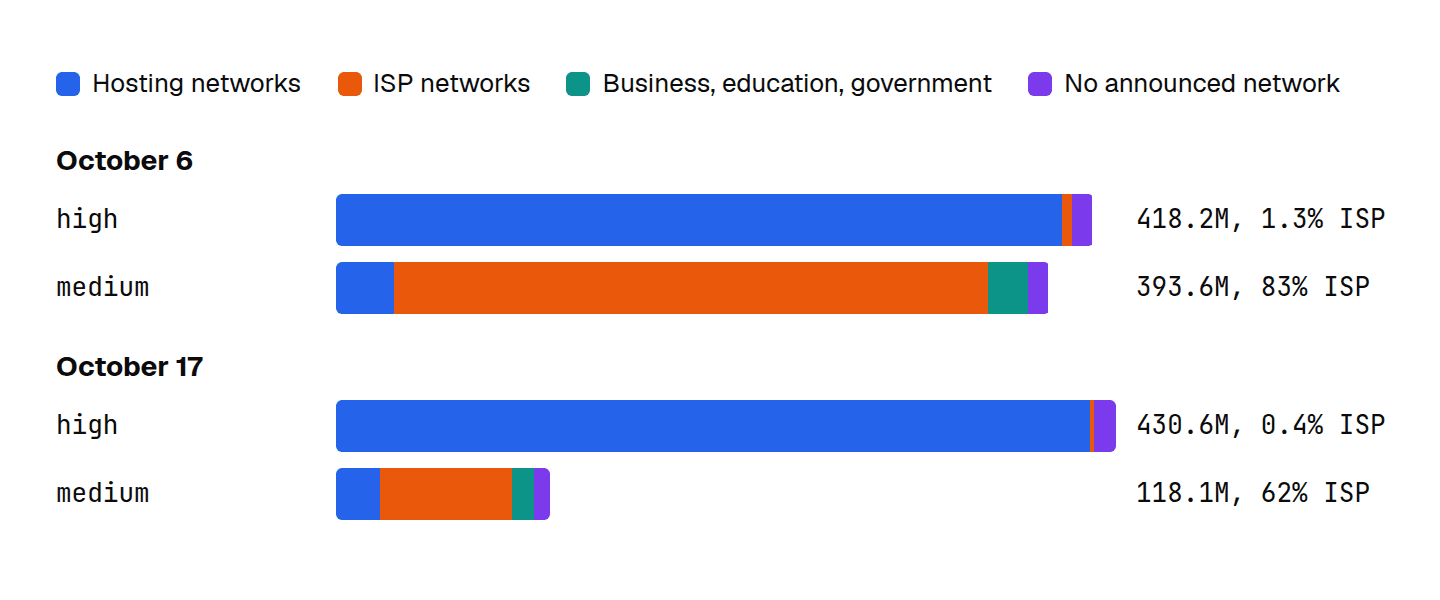
The chart splits each confidence level by the type of the network announcing each address. On October 6, 83.4% of the medium addresses were in ISP networks, against 1.3% of the high ones, and medium held 16,531,500 of the 17,250,363 residential proxy exits inside the database.
What we removed
Three builds left out blocks whose own evidence reads as home broadband, and the third also blocks that read as company office networks:
| Build | Hosting IP, IPv4 | At medium | Residential proxy exits inside | High-confidence VPN exits caught |
|---|---|---|---|---|
| October 6 | 811.9M | 393.6M | 25.1% | 90.8% |
| October 7 | 776.0M | 356.1M | 19.7% | 90.7% |
| October 14 | 763.6M | 329.3M | 10.3% | 90.2% |
| October 15 | 549.0M | 118.5M | 2.9% | 89.7% |
| October 17 | 548.7M | 118.1M | 2.8% | 89.6% |
The proxy column is a share of the 68,655,204 IPv4 addresses on the 90-day list, and the VPN column a share of the 1,210,183 high-confidence VPN exits, both as of October 17. The proxy column isn't an independent test, since the changes drew on the same kind of evidence. The VPN column is.
276.2M addresses left between October 6 and October 17. 94.3% of them were in ISP networks, 4.2% in business, education and government networks and 1.3% in no announced network. 0.2% were in hosting networks. By country, the most were in the US (11.4%), Italy (8.6%), China (7.5%), the UK (6.0%) and Japan (4.8%).
13.1M addresses came in over the same days, 8.9M of them whole hosting networks we added, so the database ended 263.1M smaller.
What it cost
A check on Hosting IP caught 89.6% of the high-confidence VPN exits on October 17, against 90.8% on October 6: 14,388 fewer. Of the 17,873 exits it stopped catching, 14,108 are in ISP networks, and 7,060 belong to peer-based services, which run on volunteers' home connections.
Across every confidence level in VPN IP, the catch went from 88.4% to 80.9% of 3,841,050 exits. 275,157 of the 301,012 exits it stopped catching are VPN IP's low confidence rows, and 98.6% of those are in ISP networks. A home address that carries VPN traffic is still a home address, so a datacenter check is the wrong tool for it. VPN IP flags those addresses itself and gives its own confidence. Whether a hosting check is the right tool for VPNs at all is its own question.
What's still at medium confidence
The medium level holds 118.1M addresses on October 17, 70.0% fewer than on October 6. 62.2% of it is in ISP networks, 20.2% in hosting networks, 10.5% in business, education and government networks, and 7.1% in no announced network.
Residential proxy exits make up 1.27% of those addresses, against 0.10% of the high level's. ISP space as a whole ran at 3.3% on the 90-day list of October 9, as we measured for residential proxy false positives.
So give each level its own job:
- Block on
high. It's where we're surest a range is hosting, and 0.4% of its addresses are in ISP networks. - Score on
medium. A hit there adds to other signals rather than deciding alone. - Decide VPN traffic on VPN IP, which catches the exits in homes and outside hosting space that no datacenter list reaches.
Testing any hosting list for home broadband
The same test works on any datacenter list, ours or a free one:
- Merge the list into non-overlapping IPv4 ranges.
- Count the residential proxy exits that fall inside, as a share of the proxy list. Each is someone's home connection, so the share is a rough measure of how many home connections the list would flag.
- Count the known VPN exits inside. That's the coverage side, and it says what a stricter list costs.
- Split both counts by the type of the network announcing each address, from an ASN database, to see where the misses and the home addresses sit.
What do free datacenter IP lists cover? runs the coverage side on X4BNet's lists, ipcat and a cloud range list.
How we measured
We compared Hosting IP as built on 2026-10-06, 10-07, 10-14, 10-15 and 10-17, IPv4 only, each merged into non-overlapping ranges. The residential proxy side is every distinct IPv4 address on the 90-day Residential Proxy IP list on 2026-10-17. The VPN side is every IPv4 address VPN IP published on 2026-10-17 with a named provider, counting only those that send traffic out rather than only take connections in: 1,210,183 at high confidence and 3,841,050 at every level. Business VPN services are left out, as they are from the VPN IP export.
Network types come from the ASN database, matched to each address through IP ASN, and countries from IP Geolocation, all as built on 2026-10-17. Hosting IP is a curated catalog of hosting and cloud providers plus our own classification and scanning of datacenter networks.
Getting access
Hosting IP is rebuilt daily as gzipped CSV and MMDB downloads, and its docs list every column. To license it, see pricing or talk to us.