
On this page
iCloud Private Relay sends Safari's traffic through two hops, one run by Apple and one by a partner network, and a website sees an address from the partner's pool rather than the user's own. Apple publishes those addresses, so finding Private Relay traffic is easy. What a fraud team's other checks do to it is the harder question.
We took the 106,728 IPv4 addresses Apple's relay had in our Relay IP database on 2026-10-06 and checked each one against our Hosting, CDN, VPN and Residential Proxy IP databases from the same day.
| Check | Private Relay IPv4 | Share |
|---|---|---|
Hosting IP, high confidence | 0 | 0% |
Hosting IP, medium confidence | 67,932 | 63.6% |
| CDN IP | 0 | 0% |
| VPN IP | 0 | 0% |
| Residential Proxy IP, 90-day list | 22,150 | 20.8% |
| Residential Proxy IP, 7-day list | 10,586 | 9.9% |
| Residential Proxy IP, 1-day list | 3,327 | 3.1% |
A hosting check that takes in medium flags nearly two in three of Private Relay's addresses, and a 90-day proxy list one in five.
Who runs the addresses
Apple's second hop runs on three networks. By origin AS in public BGP, Akamai announces 70,870 of the 106,728 addresses (59,164 from AS36183 and 11,706 from AS20940), Cloudflare 19,848 (AS13335) and Fastly 16,010 (AS54113). Apple lists 6,050 IPv6 ranges as well.
Apple says an address may be shared by more than one Private Relay user in the same area, and that every connection is checked for an iPhone, iPad or Mac and a valid iCloud+ subscription. Its advice is to treat the addresses like carrier-grade NAT or a company's egress, with many users behind each one.
What a hosting check does
Every range in Hosting IP carries a confidence: how sure we are that it's hosting, with medium less sure than high. All 67,932 hits are medium, and none is high. A rule that blocks any Hosting IP hit treats 63.6% of Private Relay's addresses as server traffic. A rule that blocks high alone touches none of them.
We measured the same two tiers against VPN exits in Does blocking datacenter IPs stop VPNs?, where the medium tier caught 20.3% of exits at 1,618 addresses blocked for each one. Private Relay users are part of that cost. Check Relay IP before the hosting score, so they never pick one up.
Why a relay address lands on a proxy list
22,150 of Apple's relay addresses, 20.8%, are in the 90-day Residential Proxy IP list. Private Relay carries Safari, DNS and apps' unencrypted HTTP, and a residential proxy network routes its customers' requests through ordinary phones and computers. When one of those devices has Private Relay on, part of the proxy traffic can leave through Apple's relay, from an address other Apple users are sharing at the same time. Residential Proxy IP keeps these addresses, since each was seen as a residential proxy, and Relay IP is how you tell them apart.
For most of them the evidence is thin. The 90-day list's hits_days_pct column gives the share of the window's days an address was seen on: 8,849 of the 22,150 (40.0%) were seen on a single day, and the median on 2% of days. 4,508 were seen on at least 10% of days, and 1,680 on at least a quarter of them. The shorter lists hold fewer: 10,586 in the 7-day list and 3,327 in the 1-day.
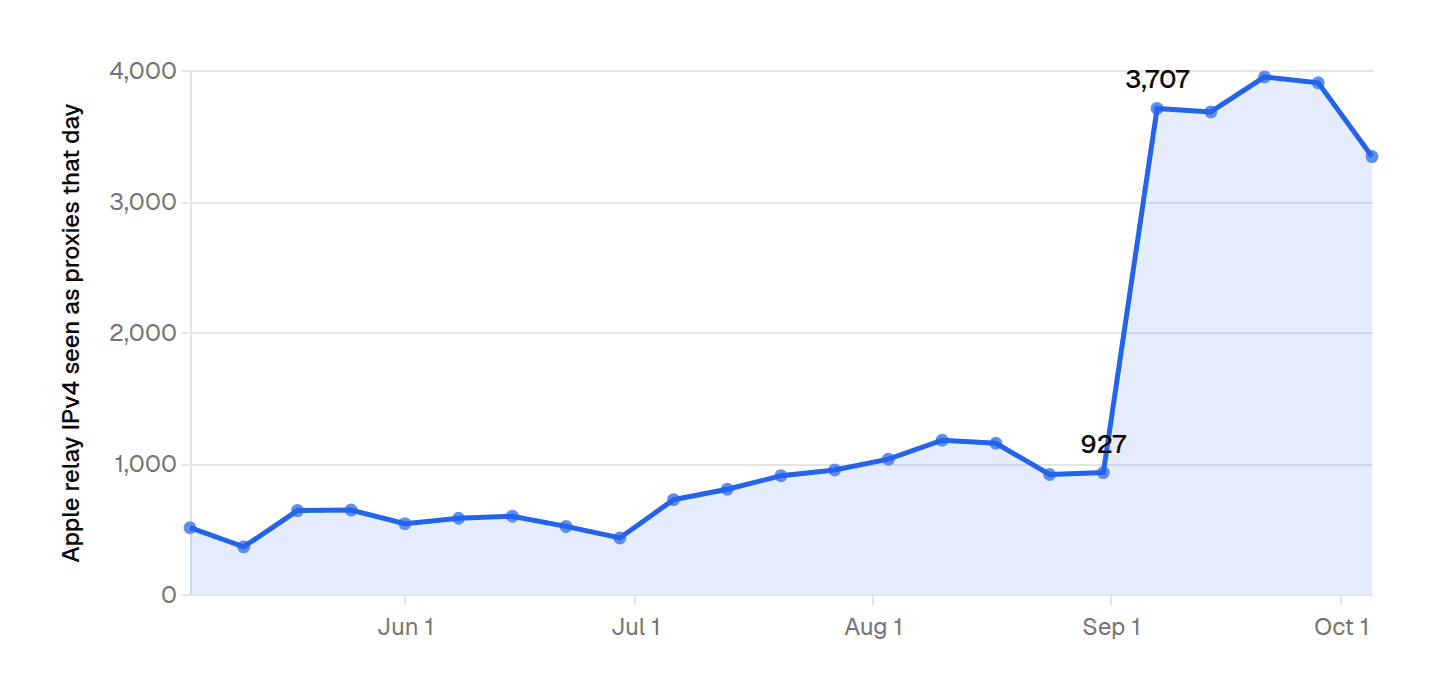
The count jumped in September. The Apple relay addresses seen as residential proxies on a single day went from 927 on August 31 to 3,707 on September 7, and stayed above 3,300 every Monday after. Over that same week, the day's residential proxy IPv4 as a whole went from 5.36 million to 5.11 million. 13,325 of the 22,150 in the 90-day list (60.2%) were first seen in September or later.
The ad-fraud argument
Pixalate's 2022 ad fraud study found that about 21% of ad traffic purporting to come from Safari on Apple devices referenced a Private Relay address, while only 1-2% came from one and behaved as Apple describes. Most of the rest looked spoofed. Its warning is against putting the ranges on an allow-list blindly, and it holds in a bidstream, where an ad request can claim any IP. A connection to your login page can't. If it arrives from an Apple relay address, it came through Private Relay.
A policy that works
Check Relay IP before anything else, and label a hit rather than block it. Skip the hosting score for it, and step up with a second factor or a challenge only when other signals fire. Fingerprint lands in the same place: blocking every Private Relay user is "a terrible idea".
An address in both Relay IP and Residential Proxy IP is shared relay egress with proxy sightings. Filter it out, challenge it or block it, as your own policy says. Weigh hits_days_pct before acting on one, or match against the 1-day list: an Apple address seen on one day of 90 says much less than one seen on a quarter of them.
Apple's ranges move slowly. Of the 105,857 IPv4 addresses Relay IP held for Apple on 2026-04-19, 105,699 were still there on 2026-10-06, 158 had gone and 1,029 had been added. On IPv6, 5,789 of 5,875 ranges stayed, 86 went and 261 were added. Since September 1, 118 IPv4 addresses were added and none removed. Relay IP is rebuilt daily, and a weekly copy keeps up.
The other relays
Relay IP covers three more services, IPv4 on 2026-10-06:
| Relay | IPv4 | Hosting IP high | Hosting IP medium | Residential Proxy IP, 90 days |
|---|---|---|---|---|
Cisco Secure Web Gateway (cisco_secure_web_gateway) | 166,413 | 17,408 | 13,824 | 145 |
Google's VPN (google_vpn) | 15,578 | 15,578 | 0 | 294 |
Google Fi VPN (google_fi_vpn) | 768 | 768 | 0 | 2 |
Cisco's gateway is where companies send their employees' web traffic for filtering, so one blocked address can shut out a whole office, and 31,232 of its addresses, 18.8%, are in Hosting IP. Every address of both Google VPNs is in Hosting IP at high, so a block on high alone blocks all of their users. The same rule holds for each: identify the relay first, then decide.
How we measured
We used each database as built on 2026-10-06, IPv4 only, expanded every relay range to single addresses and checked each against every range in the other databases. The origin networks are from public BGP routing the same day. The weekly series counts the Apple relay addresses seen as residential proxies on each Monday from May 4 to October 5, against Apple's list that day.
Relay IP is open: sign up to download it. To license the rest, see pricing or talk to us.